
What changes when an XLR cable ends in a quarter-inch plug?
A stage box, a powered monitor and a recording interface may all have an XLR connection on the back. The printed INPUT or OUTPUT label identifies the direction. The microphone or line-level marking identifies the signal the destination expects.
Read the destination’s wiring diagram
A balanced mono line can use XLR at one end and quarter-inch TRS at the other when the wiring matches. A TS mono plug does not provide the same set of contacts. Take a photo of the mating socket and check the signal level before selecting among the XLR-to-quarter-inch options.
Allow space where the plug latches
A long XLR extension should reach its destination by the actual stage or wall route. Leave room to press the latch at each connection. If a dropout follows one particular cable when you swap it between channels, mark that cable for inspection before the next session.
Will adding an extension change the connector orientation?
An XLR male-to-female extension normally preserves the mating arrangement at the far end of the original cable. A gender-changing adapter does something different. Write down which exposed end remains after extending the run and confirm the destination will accept it before ordering a whole stage loom.
Extend a stage feed without changing its destination
A venue might leave a balanced XLR feed at the wall while the recorder is now on a table several feet away. Record the gender at the wall and the input on the recorder. A six-foot male-to-female balanced extension such as 10XR-01206 can extend a matching route. The fifty-foot 10XR-01650 instead finishes in a quarter-inch TRS plug and is relevant only if the receiving input accepts that connection. Ask what level the venue sends and what level the recorder accepts. During sound check, record someone speaking and listen back through the recorder, so you know the signal actually reached the destination. Name the test recording after the venue output used that day.
Why does one microphone sound fine alone but thin beside a second mic?
Two microphones covering the same source can interact when their signals are mixed. Before replacing both XLR leads, compare each channel alone and then listen with both channels together. Keep the microphones in position and exchange the cables for a documented, known-good pair. If the change follows one cable, a cable tester can check the pin assignments against its specification. If it follows the microphone placement, investigate distance and timing with the sound engineer. A mixed recording that changes as someone moves one microphone points to a different decision than a lead with a confirmed wiring error. Note which mixer channels and microphones you used. This helps a repair shop assess the suspect assembly without trying to recreate the whole stage.
Compare parts for your setup
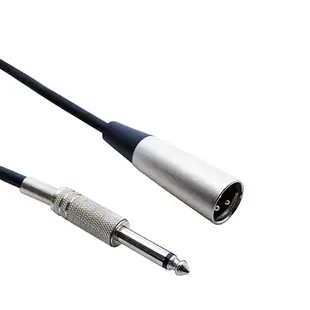
XLR Male to 1/4 inch Mono Male Audio Cable, 6 foot
10XR-01406
- Connector references
- XLR Male
- Dimensions in listing
- 1/4 inch
- Length
- 6 ft
Match the pin count, connector sex and input signal level, especially if the other end is a quarter-inch plug. Measure the installed route against this 6 ft length.
XLR Audio Extension Cable, balanced, XLR Male to XLR Female, 100 foot
10XR-012HD
- Connector references
- XLR · XLR Male · XLR Female
- Length
- 100 ft
Match the pin count, connector sex and input signal level, especially if the other end is a quarter-inch plug. Measure the installed route against this 100 ft length.
XLR Female to 1/4 inch TRS/Stereo Male Audio Cable, 6 foot
10XR-01606
- Connector references
- XLR Female
- Dimensions in listing
- 1/4 inch
- Length
- 6 ft


