
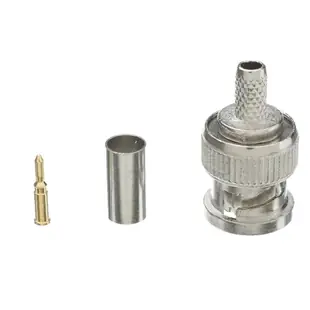
How do I choose a BNC connector for an existing coax cable?
A BNC plug that locks onto a panel can still be the wrong size for the cable you need to terminate. Read the cable designation directly from its jacket, including any letters after RG59 or RG6, and identify its intended signal. Keep that information with a close-up of the damaged end.
Which connection is actually missing?
A crimp connector attaches to bare coax. A T connector joins three already terminated connections in a layout designed for a branch. A right-angle adapter changes the direction at the panel. These parts share the bayonet fitting but solve different problems. Note which side must accept a plug and which side must lock onto a jack.
Will it work with my tool?
Match the connector manufacturer’s approved cable and crimp-die dimensions. A kit described as two-piece or three-piece can have different assembly requirements. For a shop repair, take the cable offcut and the tool model to the parts comparison. A fitting that rotates on the jacket after assembly deserves inspection before it goes back into service.
Can I identify impedance from the locking collar?
The collar tells you how the plug fastens. Use the stamped part number and the manufacturer's data sheet to establish electrical characteristics. Keep otherwise similar BNC connectors in labeled bins by family and cable size. That matters when a workshop handles both test equipment and broadcast video assemblies.
Build a small bin of spares for the service bench
An equipment bench might need three BNC pieces with entirely different jobs. A crimp connector finishes a bare cable, a female feed-through couples two completed plugs, and a T adds a branch when the system is designed for one. The 200-135 is a female crimp connector listed for RG59/62. It cannot take the place of a T such as 31X1-05610 when the job explicitly calls for branching. Keep each type in a separate labeled bag with the coax family and impedance where specified. When ordering replacements, record the part number from the bag alongside the model of the equipment that uses it. Check the matching bench receptacle before standardizing a spare-bin part number.
When does a removable bulkhead make sense?
At a rented studio, equipment comes and goes while the cable behind the desk stays in place. A panel-mounted BNC feed-through can give operators an accessible point to connect their working lead. Start with the panel drawing. Check hole size, panel thickness, retention hardware and available depth behind it. A standard inline coupler may join two plugs but lack a way to stop the assembly rotating in the panel. If the setup requires isolation from the mounting surface, confirm that feature in the drawing for the exact fitting. After choosing the matching electrical specification, have the technician check the connection with the panel in its final position and enough room to operate the bayonet collar without twisting the cable behind it.
Compare parts for your setup
RG58 Solid Core BNC Male Crimp Connector, 50 Ohm, 3 Piece Set
31X1-05500
- Connector references
- BNC Male
- Coaxial designation
- RG58
- Impedance
- 50 Ohm
- Package quantity
- 3 Piece
Choose a cable-end connector for a new lead or a barrel coupler to join finished leads. The pack contains 3 pieces; count the parts required per installation.
BNC Panel Mount Coupler, BNC Female to BNC Female
30X3-BNCPM
- Connector references
- BNC · BNC Female
- Mounting
- Panel Mount
RG6 BNC Twist On Connector, for dual shielded cable
ASF-20122
- Connector references
- BNC
- Coaxial designation
- RG6


