
Replace a BNC camera lead or a coax-and-power run
Start at the recorder. A twist-lock BNC input identifies the connector, but the camera’s video format and the cable’s construction still matter. Check the existing camera or distribution diagram for the required cable and maximum length before extending an installed run.
What is in a Siamese cable?
The Siamese spool listed here combines RG59 coax for video with a separate conductor pair for power under bonded jackets. A finished BNC-to-BNC lead replaces the video path only. When a camera has no power, trace the power source separately before replacing the coax. Use the camera maker’s power requirements for any replacement.
Can an elbow solve the clearance problem?
A right-angle BNC fitting can ease the turn behind a recorder near the wall. Measure room for both the elbow and the twisting collar. With several adjacent camera inputs, check that one fitting will leave access to release its neighbor when a channel needs service.
What if a recorder has multiple look-alike inputs?
Label the camera location at both ends and note the channel number before disconnecting the lead. On older systems, a monitor output on the recorder can resemble a camera input. Read the printed function first, then verify the camera responds on the intended channel after reconnecting.
Check a local monitor before moving a video rack
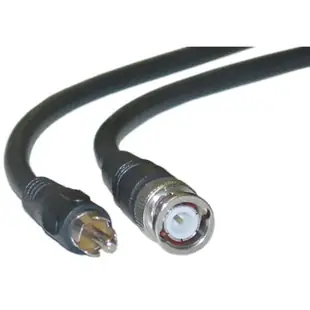
When a video rack is moving, a short lead from its source to a nearby monitor can establish whether the original picture is usable before adding the permanent run. Read the source and monitor labels. If one uses BNC and the other accepts compatible video on RCA, 11X1-02103 is an example of a three-foot, 75-ohm RG59 BNC-to-RCA lead. A BNC elbow such as 30X3-01100 addresses clearance behind equipment while retaining BNC. It serves a different job. Check one source and one screen first, then add the rack patch point so you can tell which connection changed the result. Mark the panel jack used for the reference picture before changing sources.
Can several locations share one replacement specification?
A small business with recorders in three shops may use the same model of recorder but different equipment at the other end of each coax run. Before buying a case of matching BNC leads, make a short record for each location. Include the source output, recorder input, cable marking, physical length and any power arrangement that travels separately. Ask a local employee for a photograph of the actual equipment label, avoiding a picture of the live camera view. Choose a spare specification only for sites whose interfaces and required signal match. Keep a separate note for a long or converted route. That exception can explain why a spare works at two shops and fails at the third.
Compare parts for your setup
RG59U Coaxial BNC to RCA Video Cable, Black, BNC Male to RCA Male, 75 Ohm, 65% Braid, 3 foot
11X1-02103
- Connector references
- BNC · RCA · BNC Male · RCA Male
- Coaxial designation
- RG59U
- Impedance
- 75 Ohm
- Length
- 3 ft
Inspect both ends for BNC or RCA, then verify the signal format, impedance and equipment-supported distance. Measure the installed route against this 3 ft length.
BNC RG59/U Coaxial Cable, Black, BNC Male, 100 foot
10X3-011HD
- Connector references
- BNC · BNC Male
- Coaxial designation
- RG59/U
- Length
- 100 ft
Inspect both ends for BNC or RCA, then verify the signal format, impedance and equipment-supported distance. Measure the installed route against this 100 ft length.
RG59 Siamese Coaxial + Power Cable, 20AWG Solid Copper Coax, 18/2 Stranded Copper Power, Bonded White Jacket, Pullbox, 500 foot
10X3-18291TF
- Coaxial designation
- RG59
- Wire gauge
- 20AWG
- Length
- 500 ft
- Material
- Solid Copper · Stranded Copper
Confirm whether you need a cable or adapter and match the video interface, DC connector, polarity and power requirements. Measure the installed route against this 500 ft length.


