
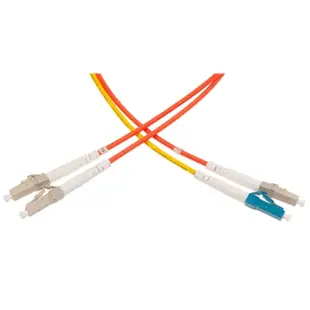
Does this legacy fiber link need a mode-conditioning patch cord?
This specialty lead belongs to specific combinations of optical transmitter and installed multimode fiber. Start with the module part number and the manufacturer’s application note. An ordinary link outage is too little information to choose one.
Which fiber and connector version should I request?
The catalog distinguishes 50/125 and 62.5/125 versions with LC, SC and ST options. Identify the installed backbone and both panel interfaces. Match the cable to the optical module’s documented use case, including any transmit-leg orientation or paired installation requirements.
What should the service record say?
Keep the module model, backbone type, lead orientation and location with the port record. The next technician then has a way to distinguish this specialty assembly from a conventional duplex cord with the same two visible connectors.
What might change after a switch replacement?
Look up the new optic independently of the retired one. The site may retain its installed multimode cable while changing the launcher and patch requirements. Have the technician mark the old cord as application-specific in the spare bin so it does not get reused automatically on the new port.
When the optical module specifically requests conditioning
Some legacy links specify a mode-conditioning patch cord for a particular optical module operating over a particular multimode plant. Retrieve the module’s installation guidance and the fiber record before choosing a cable. The LCLC-12001 lists LC ends and OM2 fiber. Another version can have different ends or be intended for a different installed core size. Confirm orientation and the module documentation with the engineer responsible for the link. A standard duplex jumper that looks similar does not supply the same launch arrangement. Keep the conditioning cord labeled beside its transceiver so a later tidy-up does not replace it unknowingly.
What to send when an optic is being replaced under a different part number
When the supplier offers a substitute module for an older gigabit link, send the exact original module, substitute model, installed fiber size, connectors and length. Ask whether the substitute has the same documented launch requirement for that fiber. An answer based only on the connector family or a shared speed label leaves the specialized cable decision open. If a mode-conditioning cord is required, have the optical technician identify its orientation and required position or positions on the network drawing. If the design calls for a conventional jumper instead, remove the specialty assembly from the parts list for that link and label it for its original use. This small inventory distinction matters when multiple cabinets contain similar LC or SC jumpers but the switches or installed fiber differ.
Compare parts for your setup
Mode Conditioning Cable LC / LC, OM2 Multimode, 50/125, 1 meter
LCLC-12001
- Connector references
- LC
- Fiber specification
- OM2 · Multimode · 50/125
- Length
- 1 m
Match the transceiver, core size, connectors and marked transmit leg to the documented application. Measure the installed route against this 1 m length.
Mode Conditioning Cable LC / SC, OM1 Multimode, 62.5/125, 2 meter
LCSC-12102
- Connector references
- LC · SC
- Fiber specification
- OM1 · Multimode · 62.5/125
- Length
- 2 m
Match the transceiver, core size, connectors and marked transmit leg to the documented application. Measure the installed route against this 2 m length.
Mode Conditioning Cable LC / ST, OM1 Multimode, 62.5/125, 1 meter
LCST-12101
- Connector references
- LC · ST
- Fiber specification
- OM1 · Multimode · 62.5/125
- Length
- 1 m


