
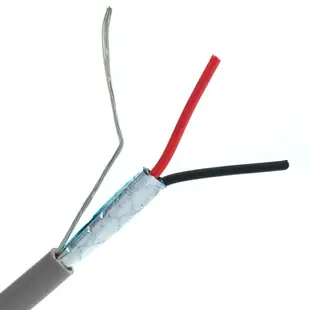
Replacing the cable for a reader, sensor or alarm contact
A request for replacement “alarm wire” becomes much clearer when it names the device, panel and cable function. An access reader may have a different specification from the contact next to it on the same door.
Which details should I collect from the service documents?
Locate the cable designation on the approved device schedule. Record the conductor gauge, number of conductors, shielding and applicable jacket rating. The assortment includes several similar-looking security wires and composite access-control cables. Color can help identify a run on site after its function is confirmed.
Can one cable listing cover every sensor?
Check each device manufacturer’s requirements and specified distance with the security contractor. For an active monitored system, coordinate service and testing with the responsible provider. Include a photo of the existing jacket and the approved schedule when obtaining a material quote.
What changes when a building has several alarm systems?
Identify the system owner for the specific point being serviced. An intrusion contact, access reader and life-safety device can share the same general location while belonging to different designs and contractors. Tag each material request with the device and system designation used in the responsible contractor’s schedule.
Planning replacement stock for an access-control project
A service van may carry several gray or white cables that look alike once the outer packaging is gone. Use the project schedule to assign a precise cable construction to each intended device. Compare a two-conductor sensor lead with a four-conductor or shielded cable only against the requirements for that circuit. Record the approved reel reference, jacket designation and usable leftover length. Keep stock labels intact when material is carried between sites. If a replacement has a different shielding arrangement or insulation rating, obtain the responsible reviewer’s decision before treating it as an equivalent.
Can last month’s leftover reel be used for the next building?
Compare the new project’s approved device and cable schedules before treating leftover wire as interchangeable stock. Read the actual reel marking and check whether the remaining material is traceable to its original documentation. Measure or establish the usable continuous length; an approximate inventory note may be too optimistic once service allowances are included. Ask the project reviewer to resolve any difference in gauge, count, shielding, conductor construction or listing. If the original identification has been lost, make that uncertainty explicit in the materials review rather than inferring suitability from color. For approved reusable stock, preserve the reel identifier and its new assignment. This lets the receiving installer connect the shipment to the specific approved material record and keeps a later replacement request from relying on someone’s recollection of a gray pull box.
Compare parts for your setup
Shielded Security/Alarm Wire, Gray, 18/2 (18AWG 2 Conductor), Stranded, CMR / Inwall rated, Pullbox, 1000 foot
10K5-52212SH
- Configuration
- 2 Conductor
- Wire gauge
- 18AWG
- Jacket rating
- CMR
- Length
- 1000 ft
Use the equipment wiring schedule to select a run that calls for 2 conductors and measure the route from the panel to the device.
Verify conductor count, gauge, construction and jacket listing for the specified circuit and installation location.
DC Male Power Plug to 2 Pin Terminal (Screw Down) Adapter
30W1-00200
- Connector references
- 2 Pin Terminal
- Configuration
- 2 Pin
Direct Burial / Outdoor Shielded Security/Alarm Wire, Black, 18/2 (18AWG 2 Conductor), Stranded, WBT/LLDPE Jacket, Spool, 1000 foot
10K5-62222MH
- Configuration
- 2 Conductor
- Wire gauge
- 18AWG
- Mounting
- Direct Burial
- Length
- 1000 ft


