
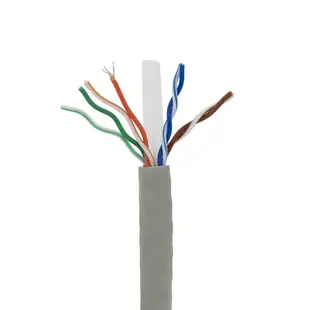
Choosing bulk cable for a building, a workbench or a repeat installation
A box marked 1,000 feet answers how much cable you are buying. It still leaves the most expensive questions open. What signal will travel over it? Will the finished cable stay in place or move with a device? Which connectors will the installer use? A spool that suits a row of office network drops can be a frustrating choice for flexible test leads. Work through one representative run before multiplying it by the number of desks, cameras or rooms.
Which bulk Ethernet cable suits the job?
For a fixed network run, check the specified Ethernet category, conductor construction, conductor gauge, shielding and jacket markings. For repeated patching on a bench, flexibility can be important. The catalog illustrates the difference with a solid Cat5e riser-rated pull box and stranded Cat6 part 10X8-021SH. A buyer can need both in the same building. Ask the installer which jacks and plugs accept the chosen conductor type, diameter and cable jacket. For powered access points or cameras, add the exact equipment and intended cable length to the brief so the network designer can check the power requirements.
How many feet should I order for several rooms?
Draw a line for each drop from the equipment room to the wall outlet. Measure the actual path up the wall, across the route and down again. Add the service allowance specified by the installer at each end, plus any planned moves. Calculate each uninterrupted run individually. A project can use 970 feet in total and still leave two short pieces that cannot complete its longest drop. A simple cut list with room, measured length, allowance and assigned reel makes that visible before anyone opens a box.
What changes when the project uses coax, speaker wire or fiber?
Coax has a center conductor and shielding. Match its RG designation and construction to the equipment and the termination method. Speaker cable uses conductor sizes and counts such as 16/2 or 14/4. Read the design for that speaker circuit before substituting between them. A bulk fiber spool adds another decision. OS2 single-mode and OM3 multimode describe different optical paths, and a reel can hold anywhere from a small duplex cable to many strands for a backbone. Record the optics and strand count alongside the jacket requirement.
What should the purchase order say?
Include the full manufacturer part number, conductor or fiber specification, length per unit, number of units, package type and required jacket marking. Specify colors when they identify separate systems at the site. Ask for the reel label or cut sheet when comparing quotations. If one quote lists two 500-foot units and another lists a single 1,000-foot unit, check the longest run on the cut list. Finally, identify who supplies the terminations and who will test the finished runs. Both can change what needs to arrive with the cable.
Compare parts for your setup
Cat6a Gray Copper Ethernet Cable, 10 Gigabit Stranded, UTP (Unshielded Twisted Pair), POE Compliant, 500Mhz, 24 AWG, Spool, 1000 foot
13X6-021MH
- Ethernet category
- Cat6a
- Data rate
- 10 Gigabit
- Wire gauge
- 24 AWG
- Length
- 1000 ft
Plan multiple measured cable runs from this 1000 ft supply, allowing slack at the patch panel and each outlet.
Check the conductor gauge and construction against the plugs or jacks, and the jacket marking against the installation requirements.
RG59 RCA Compression Connector (Yellow Band) 1 pc
31X3-31201
- Connector references
- RCA
- Coaxial designation
- RG59
- Package quantity
- 1 pc
BNC Strain Relief Boots for RG6, Black, 100 Pieces Per Bag
SR-BNCHD
- Connector references
- BNC
- Coaxial designation
- RG6
- Package quantity
- 100 Pieces Per Bag
Fit a matching boot during assembly of a coaxial lead that needs support at the connector.
Compare the coax diameter and connector body; the boot is a separate accessory.


