Choosing the keystone for the cable behind the wall plate
From the front, a wall plate hides most of what matters for a replacement. Check the module type and what connects behind it. A terminated copper jack, a pass-through coupler and a fiber adapter can all occupy keystone-style openings.
How do the rear terminations differ?
An RJ45-to-110 jack accepts compatible twisted-pair conductors at the rear. A female-to-female model accepts a finished plug. If the installed link is fiber, match its connector, polish, fiber mode and strand count to the intended module. Photograph the back of a spare sample if the description is unclear.
Will it fit beside other modules?
Check the plate opening, cabinet depth and lateral clearance. Slimline jacks may be useful in dense arrangements. Verify the termination tool and cable gauge for the specific jack before ordering enough to replace a row.
How can I pilot an unusual module combination?
Build one representative faceplate or panel position with the actual neighboring modules. Verify rear cable access and front plug clearance together. Record the successful combination by plate and module part number so ordering the same color in a different physical series will not cause a mismatch later.
Decide what signal belongs in each wall-plate opening
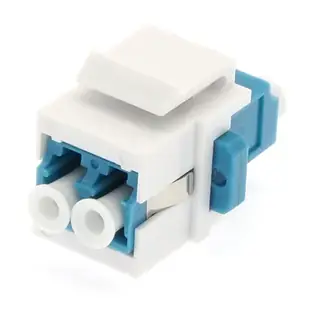
A keystone is a mounting format used for several kinds of connection. An empty opening in a desk plate may need a copper Ethernet jack, an optical coupler or another pass-through. The aqua 30LC-LC200 is a duplex multimode LC/UPC optical coupler. It fills a suitable keystone position but cannot terminate a copper network cable. Mark each opening on the room drawing and confirm the insert depth, rear access and cable bend space. Where several departments share a wall plate, keep the same identifiers on the plate and in the closet so service staff can trace each connection.
Feed-through insert or termination jack?
For a copper outlet, a feed-through insert usually accepts a plug on both sides, while a termination jack receives individual conductors at the rear. Decide which connection is already present behind the wall plate and whether the project permits that arrangement. A preterminated cord behind a shallow plate needs room for a complete plug body and cable exit. A terminated jack needs room for its own housing, the cable and its approved termination procedure. For fiber positions, choose the optical adapter and the matching polish, mode and strand arrangement. Label the front function clearly if copper and optical inserts share one plate. Before ordering fifty identical faces, build one sample in the actual box. Plug in the intended equipment lead and check whether its tab or optical latch can be released without disturbing the neighbor.
Compare parts for your setup
LC/UPC Keystone Coupler, Singlemode, Duplex, Blue Body
30LC-LC203
- Connector references
- LC/UPC
- Configuration
- Duplex
- Fiber specification
- Singlemode
Cat5e Keystone Jack, White, Toolless, RJ45 Female
311-120WH
- Connector references
- RJ45 Female
- Ethernet category
- Cat5e
Shielded Cat6a Keystone, In-Line Coupler, RJ45 Female
33X6-50000
- Connector references
- RJ45 Female
- Ethernet category
- Cat6a