
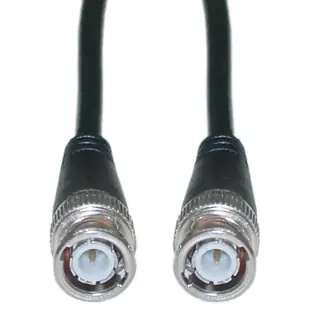
Buying a finished 50-ohm BNC lead for legacy network or test equipment
A bayonet BNC connector appears on laboratory equipment, older network devices and video hardware. Read the impedance printed on the port or required in the equipment manual before choosing a finished coax lead.
Will the finished RG58 assembly fit both ends?
The catalog includes 50-ohm RG58/AU assemblies with BNC male ends and stranded center conductors. Check each port’s connector gender and the specified frequency range for the actual part. Similar bayonet fittings alone cannot identify a 50-ohm or 75-ohm signal path.
How long should a movable bench lead be?
Lay out the equipment as it will be used and leave room for service without pulling sideways on the connector. If you are making many custom lengths, compare the bulk RG58 reel and separately compatible fittings before choosing finished jumpers.
How should I order a spare for a bench instrument?
Use the instrument’s required impedance, the working lead’s end arrangement and the distance that lets the instrument move safely on the bench. Record the frequency range if the manufacturer specifies one for the application. Keep the spare assigned to that setup when physically similar video leads are stored nearby.
Identify a BNC bench lead before it enters the network bin
A short BNC lead from a test instrument may end up in the same drawer as ordinary video cables. Part 10X1-01103 is explicitly listed as a 50-ohm RG58/AU assembly. Compare the device’s impedance and operating range to the complete cable specification and check both ends. A visually similar lead from a video installation may be intended for 75 ohms. Label the finished lead with function and length so another technician can return it to the instrument. If a coupler or adapter will be part of the path, include its impedance and frequency rating in the comparison.
Compare an extension with a single longer instrument lead
A test bench may need extra reach only on the days when a large instrument sits at its far edge. One approach is a correctly specified longer assembly. Another adds an appropriate inline connection and a second lead. The latter makes the setup adjustable, but it also introduces another mating pair and another component whose impedance and operating range matter. Check the instrument manufacturer’s requirements, especially when repeatability matters across repeated measurements. Record whether adapters or couplers were present in the original working setup. When comparing two test results, a different cable arrangement can be relevant even though the instrument settings are unchanged. For a permanent bench, label the agreed reference lead and store the extension separately. That makes it possible to recreate the original test path before attributing a changed result to the equipment under test.
Compare parts for your setup
BNC RG58/AU Coaxial Cable, 50 Ohm, 0-4 GHz frequency, Black, BNC Male, Copper Stranded Center Conductor, 45% Braid, 100 foot
10X1-011HD
- Connector references
- BNC · BNC Male
- Coaxial designation
- RG58
- Impedance
- 50 Ohm
- Length
- 100 ft
Verify impedance, connector types, frequency rating and loss over the required distance. Measure the installed route against this 100 ft length.
Bulk RG58/AU Coaxial Cable, Black, 20 AWG, Copper Stranded Center Conductor, Braided Shield, Spool, 1000 foot
10X1-022MH
- Coaxial designation
- RG58
- Wire gauge
- 20 AWG
- Length
- 1000 ft
Check the specified impedance, center conductor and connector or tool dimensions against the exact cable. Measure the installed route against this 1000 ft length.
Bulk RG58/U Coaxial Cable, Black, 20 AWG, Solid Core, Braided Shield, Spool, 1000 foot
10X1-022NH
- Coaxial designation
- RG58/U
- Wire gauge
- 20 AWG
- Length
- 1000 ft


